She has been with you for fourteen years. She runs onboarding, handles the difficult suppliers, knows where every file is and why the invoicing process works the way it does. One morning she hands in her notice. You have 30 days.
The question is not whether you can replace her. You can hire someone to fill a role. The question is: what do you actually lose?
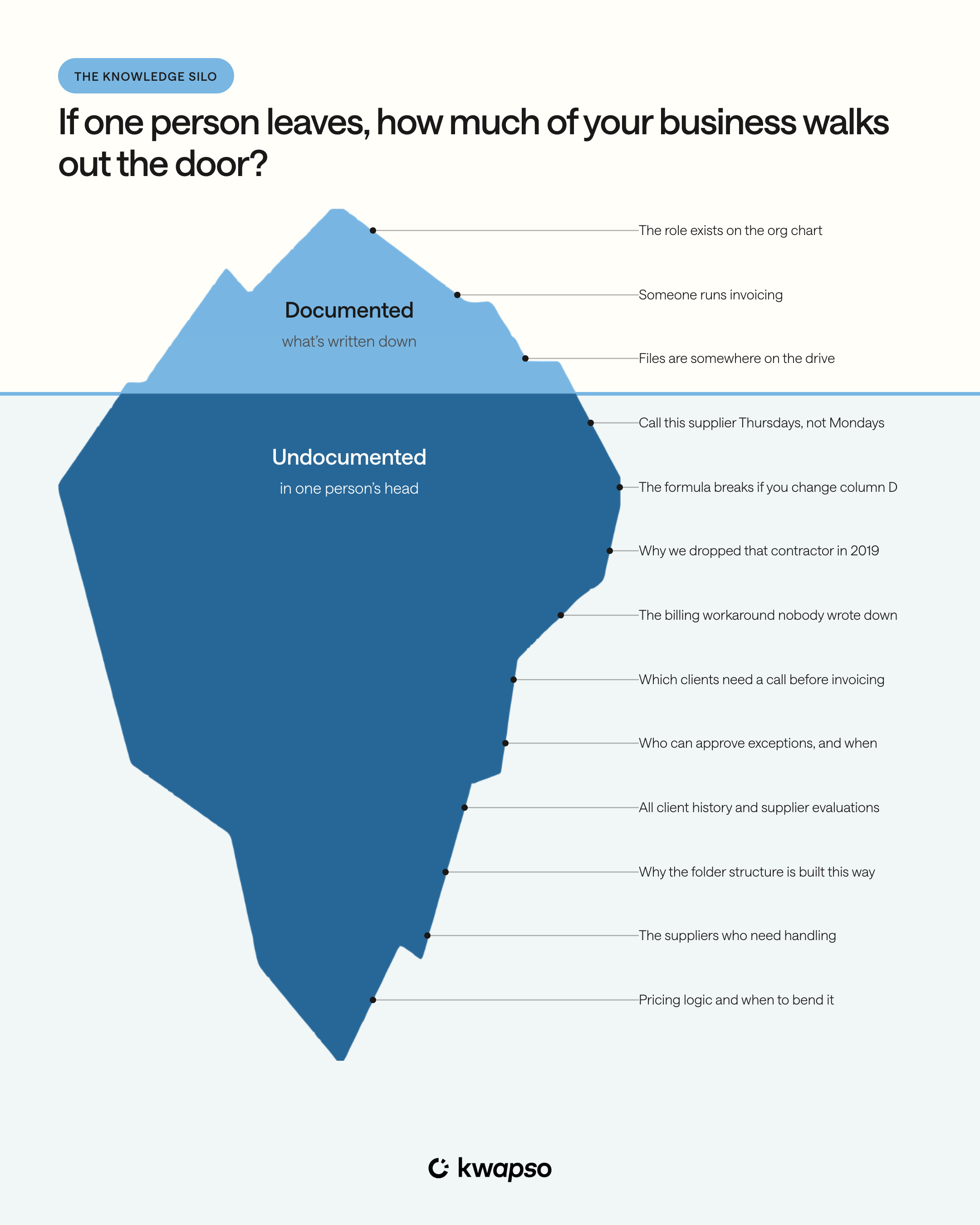
The supplier who needs to be called on Thursdays, not Mondays. The spreadsheet formula that breaks if you change column D. The reason you stopped working with that contractor in 2019. The workaround for the billing system that nobody documented because she just knows how it works.
That is not an employee leaving. That is a piece of your operational infrastructure walking out the door.
We call this a knowledge silo. And in over 150 operational conversations with CEOs across the DACH region, we have yet to meet a business that does not have at least three of them.

That is not an employee leaving. That is a piece of your operational infrastructure walking out the door.

What is a knowledge silo, and why does every established business have them?
The kwapso definition: Knowledge Silo. Critical operational knowledge (how something is done, where something is stored, why a process works a certain way) that lives exclusively inside one person's head. There is no documentation. There is no backup. There is no second person who could step in.
Knowledge silos are nobody's fault. They form naturally. A person does a job for years, gets good at it, accumulates shortcuts and context, and nobody asks them to write any of it down. The business grows around them. They become load-bearing walls that nobody planned and nobody notices, until someone tries to remove one.

72% of companies have at least one employee whose sudden departure would significantly disrupt operations (Society for Human Resource Management (SHRM). 71% of small businesses depend on one or two key individuals for organizational success (WorkFlawless).
These are not weak businesses. These are businesses that grew through the strength of their people and never built the systems to hold what those people know.
Why is this becoming urgent now?
This has always been a risk. What has changed is the timeline.
The Statistisches Bundesamt's 16th coordinated population projection shows that Germany's working-age population (20–66) will shrink by at least three to five million people by the mid-2030s, and by nearly nine million by 2040 without net immigration. The babyboomer generation begins retiring through the late 2030s. By 2035, every fourth person in Germany will be 67 or older. In Austria, the joint BMWET–WKÖ Nachfolge-Taskforce reports that 52,500 companies face succession between 2025 and 2034, affecting around 705,000 employees. Roughly half have no successor identified. The DIHK Fachkräftereport 2025/2026 shows 36% of companies already reporting hiring difficulties. In skilled trades alone, 125,000 businesses face generational transition within five years. An estimated 80,000 jobs were lost in 2024 because owners found no successors.
The people who carry the most knowledge are the ones closest to leaving. And the replacement timeline is not what most businesses assume. In the work we do with mid-sized service businesses, it consistently takes 18 to 24 months for a new employee to reach the operational depth of the person they replaced — assuming the institutional knowledge was documented before the predecessor left. Without that documentation, the gap can stretch beyond three years.
The DIHK Fachkräftereport 2025/2026 makes the consequence concrete: almost one in four German companies expect to lose company-specific knowledge through age-related employee departures. In industry, more than one in three. The people who carry the most knowledge are the closest to leaving. The replacement timeline is not what most businesses assume.
This is not a future problem. It is happening now. The question is whether your business is documenting what it knows before the people who know it are gone.
How do you find the knowledge silos in your business?
The good news: finding them is not complicated. It takes an honest afternoon, not a consulting engagement. Here is the exercise we use.
The Knowledge Silo Diagnostic
Pick your five to ten most critical roles (not necessarily the most senior, the ones where the work would stop if the person disappeared). For each one, answer these five questions:
- If this person were unavailable for two weeks, no calls, no emails, what would stop or slow down?(Nothing critical = low risk | Some tasks delayed = moderate risk | Major functions halt = high risk)
- What does this person know that nobody else in the business does? Think broadly: processes, client relationships, supplier history, system workarounds, pricing logic, regulatory knowledge, institutional memory.
- Is any of that knowledge written down somewhere the team can access?(Fully documented = low risk | Partially = moderate risk | Only in their head = high risk)
- Could someone else step in using existing documentation and training materials? How long would it take them to be effective?(Days = low risk | Weeks = moderate risk | Months or impossible = high risk)
- What is the business cost if this knowledge is lost? Consider: client relationships at risk, process disruption, revenue impact, recovery time, the cost of mistakes during the learning curve.
If you find yourself answering "high risk" more than once for the same person, that person is a knowledge silo. If you find it for three or more people, your business has a structural dependency problem.
The heat map
For a sharper picture, draw a simple matrix. List your team members (or roles) on one axis. List your critical knowledge areas on the other: client management, invoicing, scheduling, supplier relationships, project delivery, compliance, system administration, pricing.
Mark who knows what. Where only one name appears in a column, you have a silo. Where no name appears, you have a gap.
This exercise is not a performance review. It is a structural map. The goal is not to evaluate people. It is to see where the business is fragile because knowledge is concentrated instead of distributed.
.png)
The usual suspects
Across the businesses we work with, the same silo patterns show up repeatedly:
- The person who "runs" invoicing, billing, or scheduling, and it only works because they know the workarounds that nobody documented.
- The project lead who holds all client history and supplier evaluations in their head, and whose departure would mean starting those relationships from scratch.
- The founder who is the only one who can approve, escalate, or make exceptions, because the rules were never written down.
- The long-tenured administrator who knows where every file is, because they created the folder structure fifteen years ago and nobody else understands the logic.
If you recognized your own business in any of these, you have found your starting point.

Knowledge Silo Diagnostic Kit
We built a free diagnostic spreadsheet for this exercise. It includes the five-question assessment pre-formatted for up to ten roles, with automatic risk highlighting, plus a knowledge heat map that shows where your critical knowledge is concentrated and where the gaps are.
Thank you! Your submission has been received!
Oops! Something went wrong while submitting the form.
Thank you. Your download should start automatically.
Oops! Something went wrong while submitting the form.
What does it look like when knowledge is no longer trapped?
The target picture is simpler than most CEOs expect:
Every critical process is documented somewhere the team can access. Not in a 200-page manual nobody reads. In a short, clear description that answers: what triggers this process, what are the steps, who is responsible, and what does "done" look like.
At least two people understand each critical function. Not at expert level. At "can keep things running for two weeks" level.
A new hire can become productive within weeks, not months, based on existing materials. The onboarding does not depend on one person being available to explain everything verbally.
The CEO can go on holiday for two weeks and the business runs normally. Not perfectly. Normally.
When someone leaves, the transition is measured in days of handover, not months of recovery.
This is not about replacing people
This is important enough to say directly. Documenting knowledge does not make people expendable. It makes them more valuable.
The person who no longer has to be the only one who understands invoicing can now focus on improving invoicing. The project lead who shares client history with the team can focus on building new relationships instead of being the bottleneck for every client question. The founder who documents the approval rules can finally stop being the person who has to approve everything personally.
kwapso's position is clear: we do not automate to remove humans from the business. We structure to free humans for the work that actually matters. Knowledge documentation follows the same principle. The person is more valuable when their knowledge is shared, not less.
Where AI fits: your knowledge is your competitive edge
One more dimension to this, because it connects to a question every CEO is asking right now.
Everything your best employee knows, the supplier relationships, the client preferences, the project history, the pricing logic, the quality standards, is domain knowledge. It is specific to your business. It cannot be replicated by a competitor who downloads the same AI tool.
Right now, in most businesses, this knowledge is invisible. It sits in inboxes, in people's heads, in folders named "FINAL_v12." Your competitor can use ChatGPT too. That is not your edge. AI trained on your company's own structured knowledge is the edge nobody else can copy.
But that is only possible when the knowledge is out of people's heads and into systems. The same work that protects you against knowledge loss today is the work that gives you a competitive advantage with AI tomorrow. The foundation is identical.
For the full picture on why AI needs structured knowledge to deliver value: 95% of AI Projects Deliver Zero ROI. Here's Why, and What to Fix First.
Where to start
You do not need to document every process and every person's knowledge in one project. That is how documentation initiatives die. Start with the highest-risk silo from your diagnostic and work outward.
Step 1: Run the five-question diagnostic for your ten most critical roles. Identify the top three silos.
Step 2: For each silo, identify the single most critical piece of knowledge that person holds. Not everything they know. The one thing that would cause the most damage if lost.
Step 3: Document that one thing. A short process description, a decision tree, a client relationship summary. Whatever format makes it usable. The format matters less than the act of getting it out of one head and into a shared system.
Step 4: Assign a second person to learn that function. Not to replace the first person. To provide coverage, continuity, and a backup.
Step 5: Repeat for the next silo.
Three silos addressed. Three pieces of critical knowledge secured. That alone reduces your operational risk more than any insurance policy.
Ready to map the processes behind your knowledge silos step by step? Read next: How to Map a Business Process, Even If You Have Never Done It Before
Want to understand where all your business data and knowledge currently lives? Read next: Where Does Your Business Data Actually Live?
Thinking about succession and what it takes for your business to run without you? Read next: Is Your Business Ready to Run Without You? The Operational Succession Test
Your Next Step
Knowledge silos are not a people problem. They are a structural problem. Good people become silos because the business never built the infrastructure to capture what they know. The person is not the risk. The missing system is the risk.
You now have the diagnostic, the heat map, and a five-step starting point. You can identify your top three silos this afternoon.
In practice, this work means interviewing key people, documenting processes, building the systems to hold the knowledge, and training the team to use them. It is detailed, time-consuming work, especially when the people whose knowledge needs capturing are the same people the business depends on every day.
If you want to secure your operational knowledge before it walks out the door, we start with a structured knowledge audit across your team, then build the documentation into systems your team actually uses. Sprint-based delivery, real progress every few weeks. We stay after the build.
Ready to find out what your business knows, and where it keeps it? Book a structured operations call here.
Whether you take this on yourself or hand it to us, we hope this guide makes the invisible risks visible, and gives you a clear place to start.
FAQ
What is a knowledge silo in a business?
A knowledge silo exists when critical operational knowledge, how a process works, where files are stored, why a system is configured a certain way, lives exclusively inside one person’s head with no documentation, no backup, and no second person who could step in. 72% of companies have at least one employee whose sudden departure would significantly disrupt operations (SHRM). Knowledge silos form naturally over years and are nobody’s fault, but they create structural fragility that worsens every month.
How do you identify knowledge silos before someone quits?
For each critical role, answer five questions: What would stop if this person were unavailable for two weeks? What do they know that nobody else does? Is any of it documented? Could someone step in using existing materials? What is the business cost if this knowledge is lost? If you answer “high risk” more than once for the same person, that person is a knowledge silo. Most businesses discover three or more when they run this exercise honestly.
How long does it take to replace a key employee’s knowledge?
Research indicates it takes 1.5–2 years for a new hire to reach the experience level of a predecessor. The knowledge at risk is not just technical skill: it includes supplier relationships, client preferences, system workarounds, pricing logic, and institutional memory accumulated over years. In Germany alone, 12 million people will leave the workforce by 2036, roughly 80,000 reaching retirement age every month.
Does documenting knowledge make employees replaceable?
The opposite. Employees who share their knowledge become more valuable, not less. A person who no longer has to be the only one who understands invoicing can focus on improving invoicing. A project lead who shares client history can build new relationships instead of being the bottleneck for every question. Documentation frees people from being single points of failure and redirects their expertise toward higher-value work.


