The noise around digital transformation is deafening. AI agents that promise to run your whole company. Experts insisting you should have automated everything yesterday. Software vendors flooding your inbox with "revolutionary" solutions.
If the choice paralyzes you, you are not alone.
Most business owners we speak with want to "finally automate something" or "do something with AI." Here is the problem: you cannot automate what you do not understand. AI will not help you while your operations are still unclear.
The data agrees. In McKinsey's State of AI 2025 survey of 1,993 companies, 88% report using AI, yet only about 6% see significant financial impact from it. What separates that small group is not better tools. High performers are nearly three times more likely to have fundamentally redesigned their workflows before deploying AI, and McKinsey found that workflow redesign is one of the strongest drivers of real business impact.
This guide gives you the path that actually works. Structure first, automation second, AI third, in that order.
Why do most digitalization projects disappoint?
Because they start in the wrong place. For most mid-sized businesses, digital transformation feels expensive, endless, and likely to fail. That feeling is earned: most efforts deliver far less than they promise.
The common mistake is thinking digitalization means spending hours comparing software tools. It does not start with tool-searching. It starts somewhere else entirely: with understanding what you actually do.
Most owners skip that foundation and jump straight to solutions. They research project management tools before mapping their current workflow. They compare CRM systems without documenting their sales process. They evaluate AI tools before clarifying where AI could take over and where a human decision still belongs.
Two ways to approach the same process
Tool-first: pick the software, then bend your work to fit it. Fast to start, slow to pay off, often abandoned.
Process-first: understand the work, simplify it, then build the tool around the better version. Slower to start, and the one that lasts.
This is the process-first principle, and it is the argument of this entire guide: structure before software, always.

You cannot automate what you do not understand. Structure comes before software, always.

The process-first path, step by step
Step 1: Make every step visible
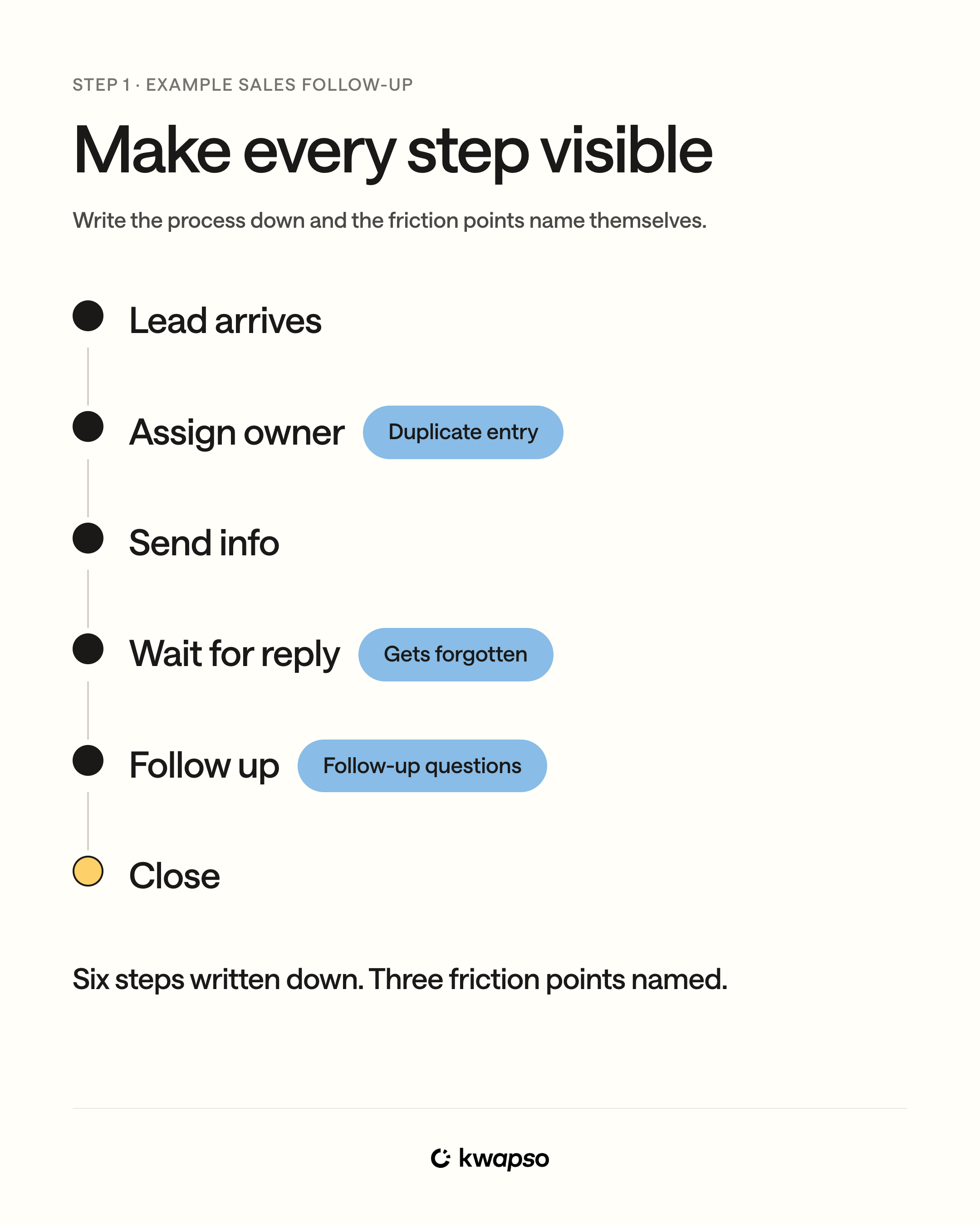
Pick one process that consistently frustrates you: sales follow-ups, employee onboarding, expense approvals. Open a document and write down every single step. Who does what? Which decisions get made? Where does it get stuck? Where do people hunt for information or ask follow-up questions? Where is data copied or entered twice?
Do not solve anything yet. Do not search for software. Just make visible what already exists, from the first action to the moment the task closes.
Step 2: Quantify the chaos
Now put real numbers on the current state, and question what deserves to be measured at all. How often does the process run? How many hours a week does it consume? Who is involved, and for how long? Track the time spent on recurring steps, the number of handoffs, how often things stall, and the errors that create rework.
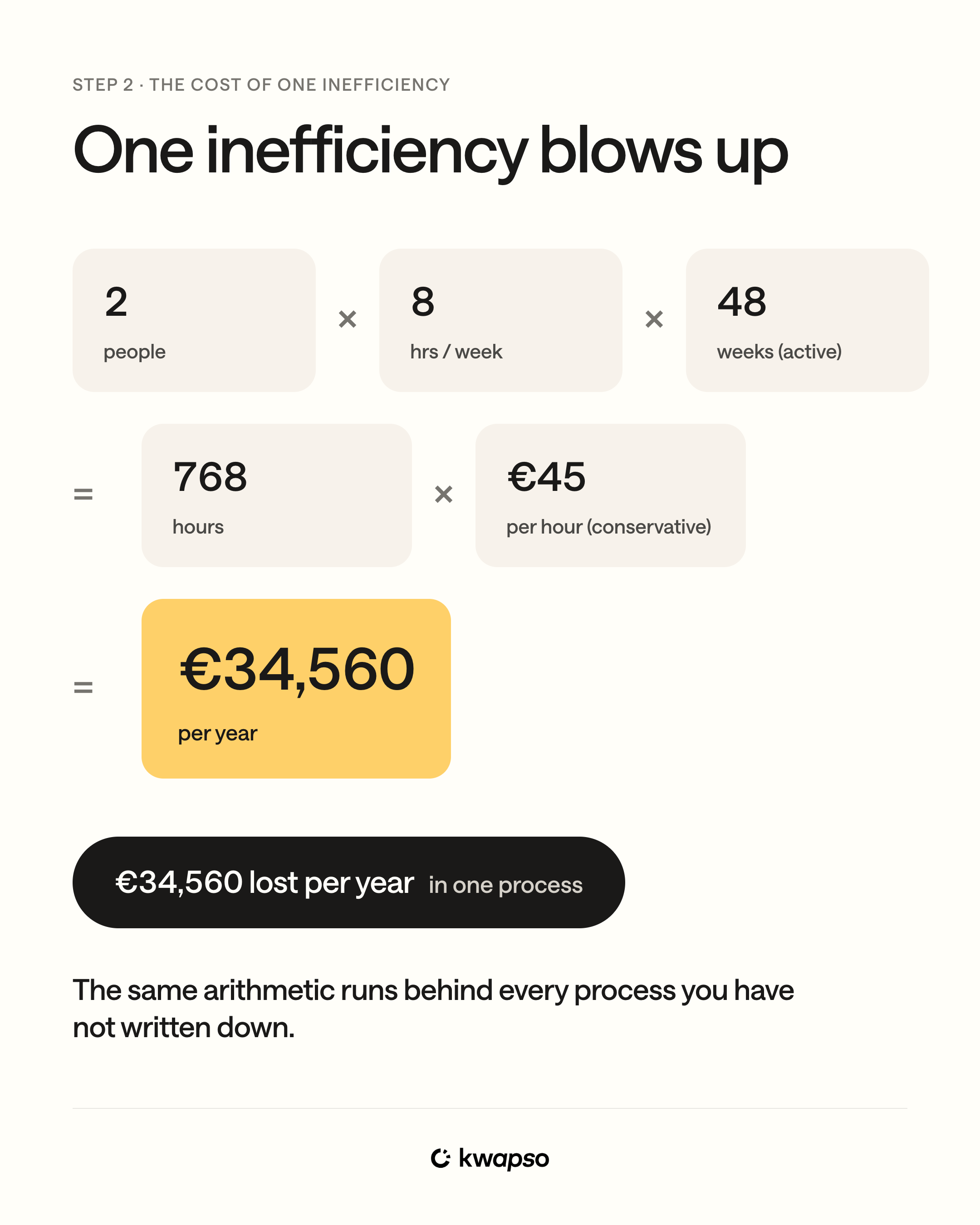
Then calculate the real cost. If two people each spend 8 hours a week on one process, that is 832 hours a year. At €45 an hour, you are losing €37,440 annually on a single inefficiency.
As you go, ask the hard questions. Is this step truly necessary? What adds no real value? What could you stop doing entirely? While mapping one client onboarding, a business found it was sending three separate "welcome" emails, because three departments had each built their own over time. The customer needed one. Two steps gone, zero loss in quality.
Behind every process sits data: customers, orders, projects, people, documents. As you analyze and cut steps, move that information out of spreadsheets and email threads into a clean, structured form, for example a relational database.
Step 3: Define your ideal outcome
If you could rebuild this process from scratch, how would it work perfectly? Think without limits first. What would the experience be for everyone involved: your team, your customers, your suppliers, you? How would customers notice the improvement: faster answers, fewer errors, better communication? What information should appear automatically the moment someone needs it, instead of being hunted for? Where would decisions happen faster? What would remove the most frustration?
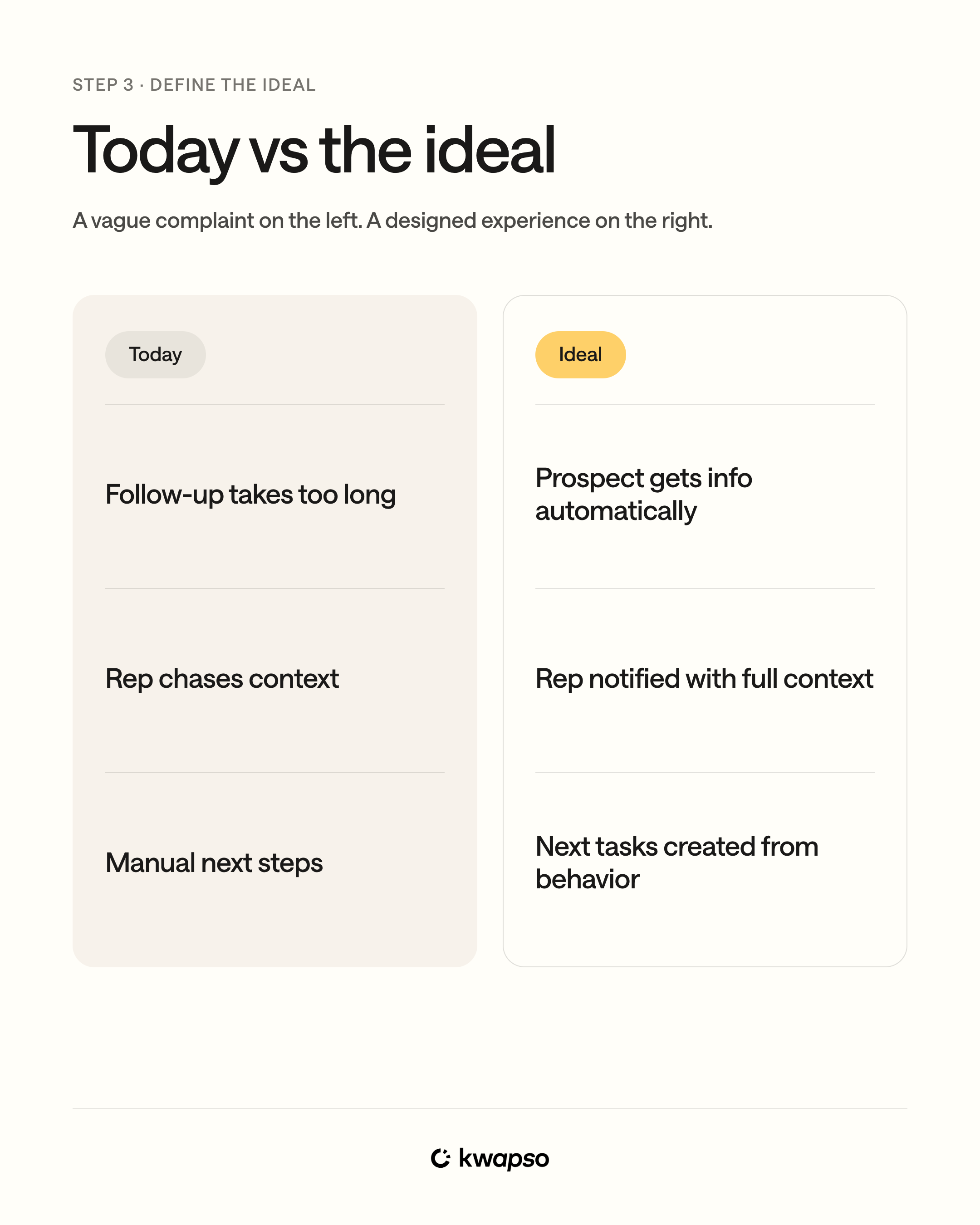
Make it concrete. Instead of "sales follow-up takes too long," picture this: the moment a prospect shows interest, they receive the right information automatically, the rep is notified with full context, and the next tasks are created based on what the prospect actually did.
Step 4: Simplify before you digitize
Once you know what must stay, make it as simple as possible. Combine similar steps: if you collect customer data in three places, design one. Cut approvals that add no value. Reduce handoffs. Replace "use your judgment" with clear if-then rules.
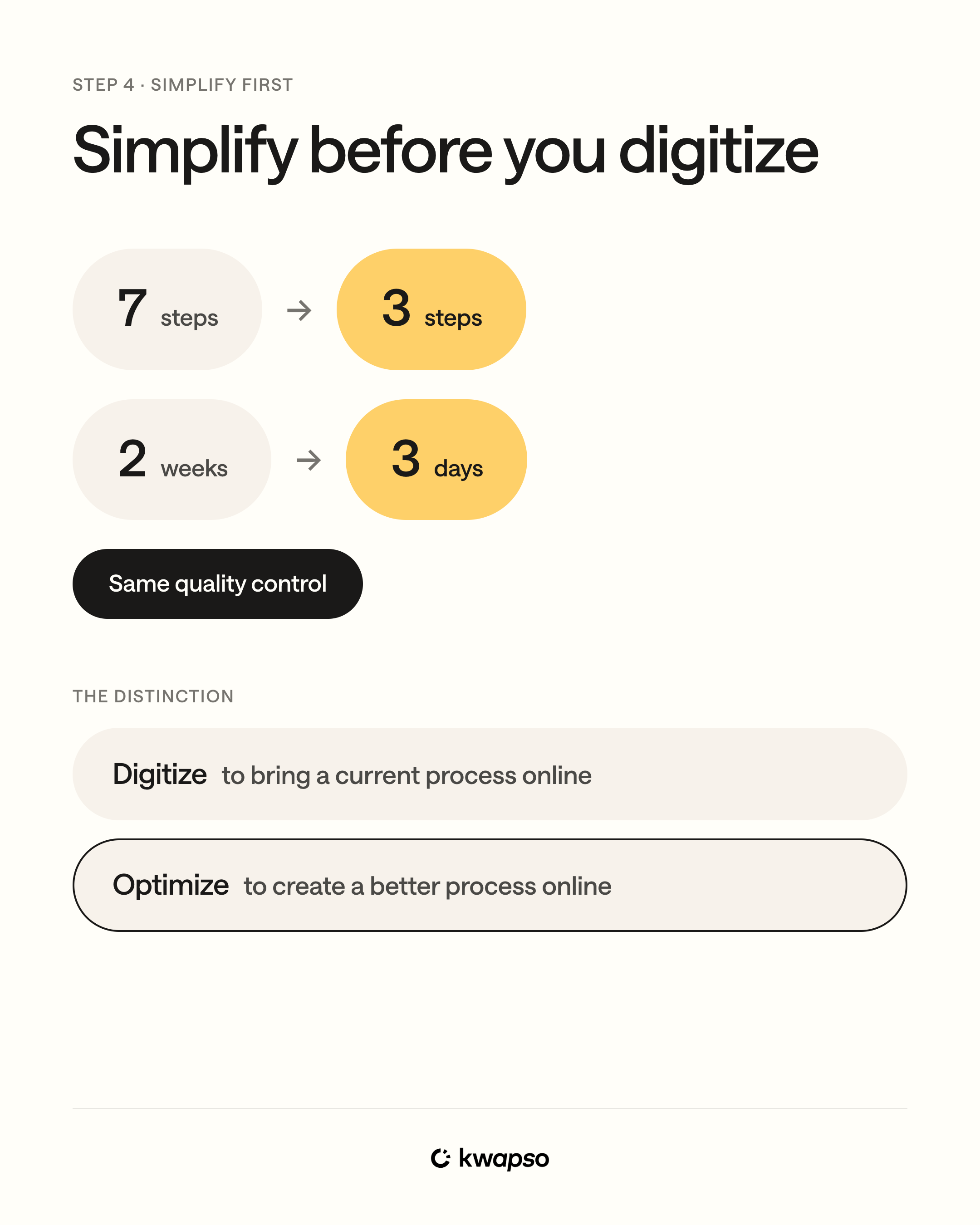
One client approval process had seven steps and took two weeks. After simplification: three steps, three days, the same quality control.
This is the difference between digitizing and optimizing. Digitizing puts your current process online. Optimizing improves the process first, then puts the better version online. Always optimize first. Otherwise you simply make a broken process run faster.
Step 5: Add intelligent automation
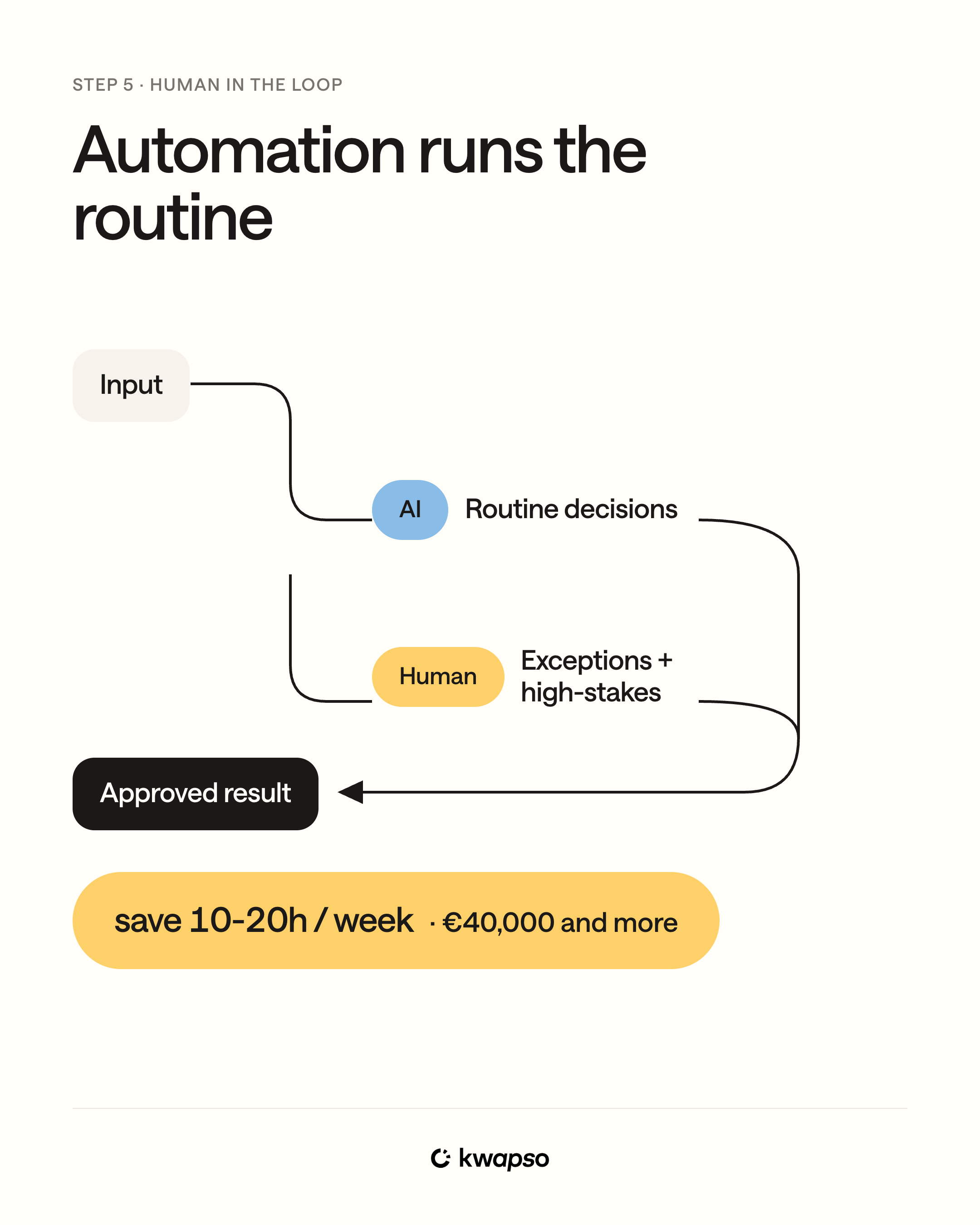
Once the process runs smoothly, bring in automation with care. Use it to analyze data and trigger actions, but keep humans on the decisions that matter. Start with something recurring and rule-based, where errors are costly, and where AI can already help. Let AI handle routine decisions and humans handle the exceptions, with approval steps for anything high-stakes.
The math is compelling. Automating a 10-minute task that runs five times a week saves 260 hours a year. At €45 an hour, that is €11,700 for maybe two hours of setup. The beginner mistakes are predictable: automating the most complex process first, automating before simplifying, and skipping a small-scale test.
Automation here is not about removing people. It frees them from repetitive work so their time lands where judgment actually matters.
Step 6: Build focused AI agents
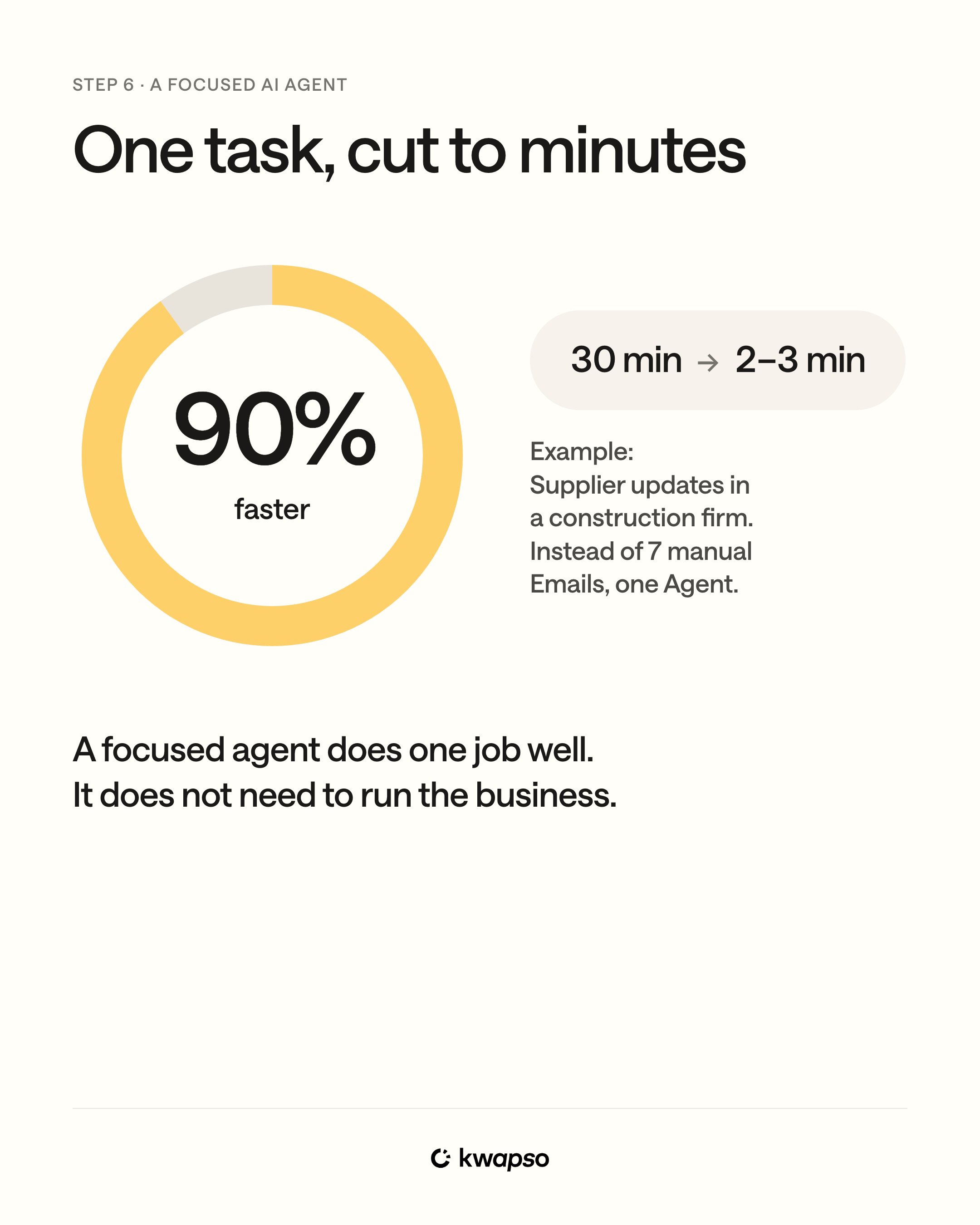
An AI agent is a digital specialist built to excel at one specific, repetitive job. It takes an input, processes it with AI trained for exactly that task, and returns a result a human only has to review. Good candidates in a mid-sized business: screening and ranking applications, analyzing customer inquiries and drafting replies, sales research and prospect summaries, document review and data extraction.
The impact is real. One construction firm cut the time to produce customer updates by 90%. Its AI agent processes project information and site photos and creates a full update in two to three minutes, work that used to take more than 30 minutes by hand.
To choose your first one, find your team's biggest time-sink that involves reading, evaluating, or analyzing, and that happens many times a day where speed and consistency matter.

We offer a free audit of one of your processes that you struggle with.
Book a free meeting here, bring your process with you and we map together a solution and it's possible impact.
BOOK HERE
What should you avoid?
Four traps sink most digitalization efforts.
- Do not spend five hours comparing tools before you know what you need: think first, shop later.
- Do not overcomplicate, because simple processes are far easier to digitize, automate, and improve.
- Do not automate before your process is clear, or you will automate chaos instead of efficiency.
- And do not build before you understand what is truly necessary, because the requirements change the moment you understand the problem properly.
Where does AI actually fit?
At the end, not the beginning. This is the part most guides get backwards. Your operational structure is the prerequisite for AI, not an add-on to it. Clean data, documented processes, and clear roles are what make automation and AI work at all. That is exactly why high performers in McKinsey's 2025 research redesign their workflows first and treat AI as the layer on top.
Put plainly: your operational health is your AI readiness. Fix the structure, and automation and AI stop being a gamble and start being a multiplier.
Your Next Step
Digitalization is not about finding the perfect tool or chasing the latest AI trend. It is about understanding your processes well enough to improve them systematically. That is the whole game.
You now have the process-first path: make it visible, quantify it, define the ideal, simplify, automate, then add focused AI. The thinking is free. The hard part is the time and the expertise to do it well while you are also running the business, which is where most owners get stuck.
That is where kwapso comes in. We map your processes, run a structured audit, simplify before we build, and deliver in focused sprints, and we stay after the build rather than handing you a tool and walking away.
Ready to see where your operations actually stand? Take the free Betriebs-Check here.
Whether you take this on yourself or hand it to us, we hope this guide gives you a clearer first step than "buy more software."
Where should digitalization start in a mid-sized business?
It starts with understanding your current processes, not comparing tools. Map one frustrating process step by step, quantify its cost, and simplify it before choosing software. McKinsey's State of AI 2025 survey of 1,993 companies found high performers are nearly three times more likely to redesign workflows before deploying technology, and that redesign is one of the strongest drivers of financial impact.
Why do so many digital transformation projects fail?
Most fail because they bolt technology onto a broken process instead of fixing the process first. In McKinsey's State of AI 2025 research, 88% of companies use AI but only about 6% see significant financial impact from it. The difference is not better tools: high performers redesign their workflows first, then add technology on top of a clean, understood process.
Should I fix my processes before using AI?
Yes. AI amplifies whatever process it runs on, so unclear data and undocumented steps get amplified too. Clean data, documented processes, and clear roles are what make AI work. McKinsey's State of AI 2025 survey found high performers are nearly three times more likely to have fundamentally redesigned workflows before deploying AI, which is why structure comes before automation and AI.
How do I calculate the cost of an inefficient process?
Multiply the people involved by the hours they spend and the weeks per year, then by an hourly rate. Two people spending 8 hours a week on one process is 832 hours a year, or €37,440 at €45 an hour. That turns a vague frustration into a number, and it tells you which process to fix first before spending anything on software.